
Guides
ChatGPT Ads: How ChatGPT Advertising Works, What It Costs and How to Start
 Matan Shahar, AI GTM Lead

How ChatGPT ads work: who sees them, formats, targeting, costs and minimum budgets, Ads Manager setup, policies and measurement. Based on OpenAI's docs.
ChatGPT ads are paid, clearly labeled placements that appear below ChatGPT's answers for people on the Free and Go plans. Businesses based in 89 countries can buy them through OpenAI's self-serve Ads Manager at ads.openai.com, which has been in beta since May 5, 2026.
Brandlight read OpenAI's advertiser help center, ad policies and product announcements, and looked through Ads Manager in an advertiser account, to write this guide. It covers how ads are matched to conversations, what they cost and how to launch a campaign. It also covers what you cannot advertise, and what the reporting does and does not show. Everything here reflects the beta as of November 16, 2026.
Key takeaways
- What they are. A ChatGPT ad is a sponsored card under an answer. It shows the advertiser's name, logo, headline, description, image and a link to a landing page.
- Who sees them. Adults on the Free and Go plans. OpenAI says Plus, Pro, Business, Enterprise and Edu accounts have no ads, and neither do accounts identified as under 18.
- How they are matched. By the context of the conversation, not by keywords. Advertisers add "context hints", which OpenAI says are not exact-match keywords and do not guarantee delivery.
- What they cost. Prices are set by auction. The minimum daily budget is $25 in the US. You are billed for impressions or clicks, never per conversion.
- What ads do not change. OpenAI states that ads do not influence ChatGPT's answers. The ads system runs as a separate service with separate models.
- What the reporting leaves out. Ads Manager reports impressions, clicks, spend and conversions. It shows no conversations, no prompts and nothing about competitors.
What are ChatGPT ads?
ChatGPT ads are sponsored placements that OpenAI sells inside ChatGPT. OpenAI calls the product ChatGPT Ads. Each ad sits below an answer, carries a label, and links to the advertiser's landing page.
OpenAI announced its plan for ads on January 16, 2026 and says testing started in the United States on February 9, 2026. A managed pilot ran from February through April. Self-serve buying opened on May 5, 2026. By October 21, 2026, OpenAI reported that more than 100,000 advertisers had run campaigns and that ads were available in 89 countries.
OpenAI still describes the product as "in beta and in the early stages of scaling". Expect formats, bidding and reporting to keep changing.
ChatGPT Ads, OpenAI Ads Manager, Sponsored Agents: which is which?
The names overlap, so here is how OpenAI uses each one.
| Name | What it is |
|---|---|
| ChatGPT Ads | The advertising product: paid, labeled placements shown in ChatGPT. Also searched for as "OpenAI ads". |
| OpenAI Ads Manager (Beta) | The self-serve platform at ads.openai.com where you create, launch and measure campaigns. Often called ChatGPT Ads Manager. |
| ChatGPT Ads Manager plugin | A plugin for ChatGPT or Codex that drafts ads, edits campaigns after you approve each change, and analyzes results. |
| Product feed ads | Ads built from a retailer's product catalog, showing image, title, price and rating. |
| Sponsored Business Agent | A labeled chat with an AI representative of the advertiser, opened from an ad. OpenAI's September announcement called the format Sponsored Agents. |
| Business Hub | The dashboard for claiming a business profile in ChatGPT. It is separate from ads. See our ChatGPT Business Hub guide. |
ChatGPT ads timeline
| Date | What happened | Source |
|---|---|---|
| November 9, 2026 | Target CPA and Target CPC bidding became available for new campaigns | Help Center |
| October 26, 2026 | Multi-image ad format opened as a beta in Ads Manager | Help Center |
| October 21, 2026 | 26 countries added, for 89 in total; more than 100,000 advertisers to date | OpenAI |
| September 16, 2026 | Sponsored Agents test, Ads Manager plugin, HubSpot and Shopify integrations | OpenAI |
| August 31, 2026 | OpenAI reported a $1 billion annualized revenue run rate; self-serve opened in India, Europe, the Middle East and North Africa | OpenAI |
| May 5, 2026 | Self-serve Ads Manager beta and cost-per-click bidding launched | OpenAI |
| February 9, 2026 | Ad testing started in the United States | Help Center |
| January 16, 2026 | OpenAI published its ads principles and announced the test | OpenAI |
How do ChatGPT ads work?
ChatGPT ads work by matching an advertiser's message to what a person is trying to do in a conversation. OpenAI's ads system reads the context of the chat, picks at most one relevant ad through an auction, and shows it under the answer. The answer itself is written by a different system.
Where ads appear
Ads appear below a ChatGPT response. OpenAI's help center says a person sees one ad unit at a time, which may contain one image or several. OpenAI is also testing a multi-image ad that shows while ChatGPT generates an image and disappears when the image is ready.
Ads do not appear everywhere. OpenAI says Temporary Chats show no ads. Its ad policies also keep ads away from sensitive conversations, including mental and personal health, political content and self-harm.
Who sees ads
Ads may appear for people on the Free and Go plans. OpenAI says Plus, Pro, Business, Enterprise and Edu accounts will not have ads. It does not show ads to accounts identified as belonging to people under 18, using stated age and age prediction.
Free users can also switch to an Ads-Free option with lower message limits and fewer tools. So not every Free user can be reached with ads.
How ChatGPT picks an ad
OpenAI says its system selects ads "based on expected relevance and outcomes". The signals it lists are:
- The context and intent of the current conversation
- The ad's landing page, title and copy
- Context hints and targeting choices the advertiser supplied
- Signals from the person's wider ChatGPT use, only when ads personalization is on
When several ads are eligible, OpenAI weighs relevance together with advertiser bids. Bidding more does not buy a slot on its own. OpenAI's engineering write-up adds that "returning no ad is an ordinary, successful outcome".
Personalized ads are not initially available in the European Economic Area or Switzerland. With personalization off, OpenAI says ads are based on the current chat thread, plus basic context such as general location and language.
Do ads change ChatGPT's answers?
No. OpenAI's wording is direct: "Ads do not influence ChatGPT's answers. Ads run on separate systems from our chat model, and advertisers have no ability to shape, rank, or alter ChatGPT's responses." Its engineers describe the two as different services with separate models and separate code.
OpenAI also says an ad is not an endorsement. Seeing an ad does not mean OpenAI recommends the advertiser.
What advertisers learn about users
Advertisers get aggregate numbers only. OpenAI says it does not share conversations with advertisers and never sells user data. Advertisers do not receive chats, chat history, memories, names, email addresses, precise location or IP addresses.
People can also manage ads in Settings. They can turn off personalization, hide or report an ad, see why an ad was shown, and clear the data used for ads.
ChatGPT ad formats
ChatGPT has two standard ad formats, single image and multi-image, plus product feed ads for retailers and Sponsored Business Agents for conversion campaigns. Every standard ad has the same parts: advertiser name, logo, headline, description, image and one landing page.
| Format | What it shows | Availability on November 16, 2026 |
|---|---|---|
| Single image | One image with headline, description and landing page | Standard campaigns with a Reach, Clicks or Conversions objective |
| Multi-image | 4 to 6 square images (1:1), one landing page, "Learn more" as the only call to action | Open beta in Ads Manager since October 26, 2026 |
| Product feed ad | Product image, title, rating, price, sale price and brand, built from your catalog | Retail advertisers who upload a feed in Ads Manager |
| Image-generation ad | Several images from one advertiser, shown while ChatGPT creates an image | In testing, per OpenAI's user help page |
| Sponsored Business Agent | A "Start chat" option that opens a labeled chat with the advertiser's agent, next to "Visit site" | Rolling out to eligible advertisers; needs a Conversions campaign |
The help pages we read do not publish character limits or image dimensions for single-image ads. OpenAI's creative guidance asks for clear, specific, benefit-focused copy and several distinct variations per offer.
Landing pages must load for OpenAI's crawlers. OpenAI says pages must not block the OAI-AdsBot and OAI-SearchBot user agents. Ads or pages its systems cannot review are not eligible to run.
Product feeds uploaded for ads stay in ads. OpenAI's product feed guide says those products "will not appear in organic ChatGPT conversations" during the beta.
Sponsored Business Agents are the newest format. OpenAI's setup guide says there is no separate charge for agent chats, and that advertisers do not receive individual transcripts. An agent built in Business Hub does not yet sync with Ads Manager. Our Business Hub guide covers the unpaid version.
ChatGPT ads targeting
ChatGPT ads targeting starts from conversation context, and advertisers steer it with context hints, location, platform and their own customer lists. There are no keywords to bid on.
| Control | Where you set it | What OpenAI's documentation says |
|---|---|---|
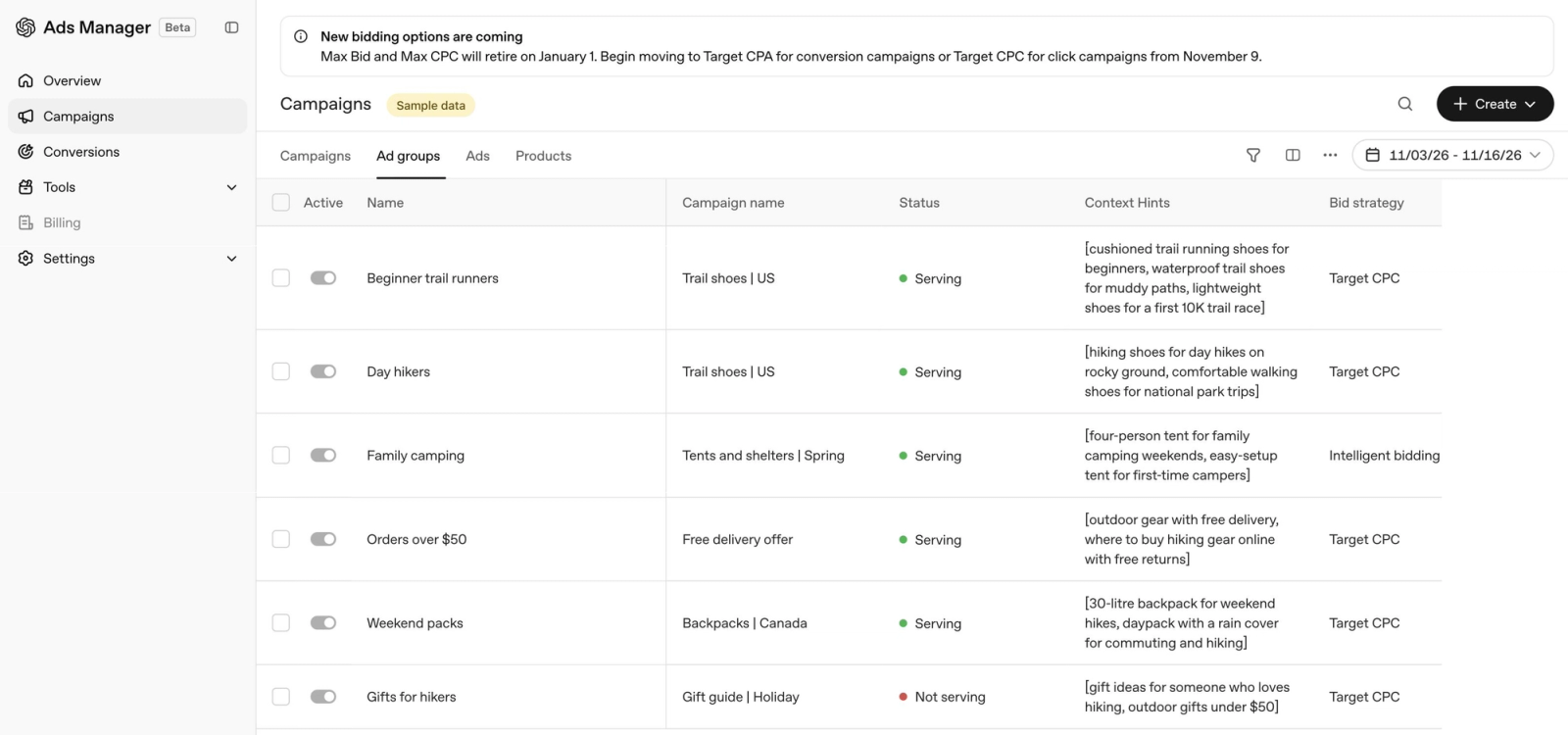
| Context hints | Ad group | Short descriptions of what you offer, who it helps and when it is useful. They inform relevance. They are "not exact-match keywords or targeting rules". |
| Location | Campaign | Countries, plus states or regions, cities, markets and postal codes where available. New product feed campaigns are country-level only. |
| Platform | Campaign | Android app, Android web, desktop web, iOS app or iOS web. |
| Custom audiences | Campaign | Upload customer or prospect lists to include or exclude. Inclusion needs at least 25,000 matched users. |
| Audience bid adjustments | Ad group | Bid 0.1x to 10x for people in a chosen custom audience. |
| Negative Phrases | Qualifying advertisers only | Narrow placement exclusions tied to a brand's own policies. |
A context hint reads like a sentence, not a keyword. OpenAI's own example is "cushioned everyday running shoes for beginners training for their first 5K", which it prefers to "running shoes". Hints cannot enforce locations, schedules or exclusions.
Two limits matter for planning. OpenAI advises against custom audiences in campaigns that target the EEA or Switzerland while personalization is unavailable there. And some new self-serve accounts can advertise only in their home country until the account builds history.
OpenAI's campaign documentation lists no demographic or interest targeting options.
How much do ChatGPT ads cost?
ChatGPT ads have no fixed price. Each placement is sold by auction, and OpenAI says "the final winning auction bid sets the price you pay". What you control is the objective, the budget and a bid or cost target. The smallest daily budget for a US account is $25.
What you pay for
Your campaign objective decides the billing event. OpenAI's billing guide describes three choices.
| Objective | Optimizes for | You are billed for |
|---|---|---|
| Views (labeled Reach in some help pages) | Visibility | Impressions served, on a CPM basis |
| Clicks | Traffic to your site | Each valid click (CPC) |
| Conversions | A chosen conversion event, such as a purchase or lead | Valid clicks (oCPC) or impressions (oCPM), your choice |
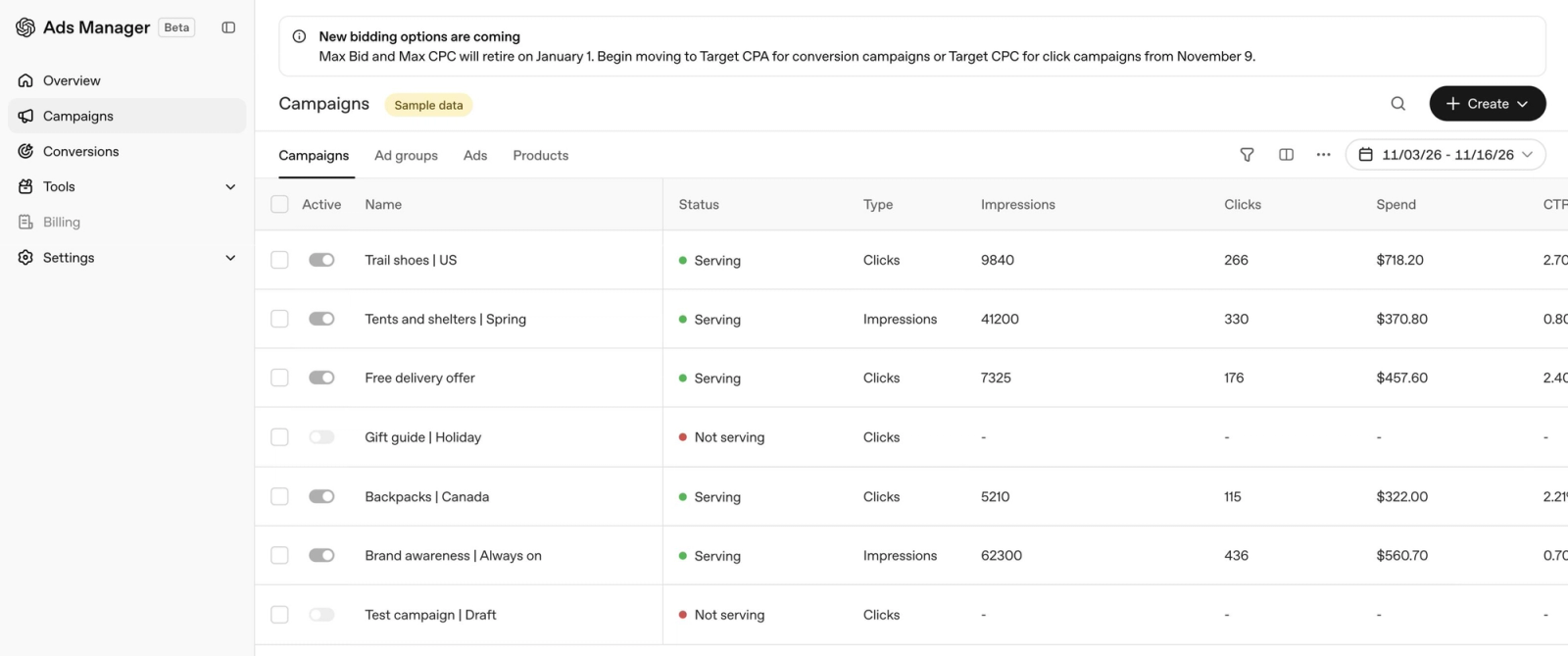
In the Ads Manager campaign table we looked at, the Type column showed these objectives as Impressions and Clicks.
You never pay per conversion. In OpenAI's words, "Ads are not billed per conversion."
ChatGPT ads minimum spend
The minimum is a daily campaign budget, set by billing currency. OpenAI's campaign guide lists 37 currencies. A sample:
| Billing currency | Minimum daily budget |
|---|---|
| US dollar | 25 USD |
| Euro | 15 EUR |
| British pound | 15 GBP |
| Canadian dollar | 25 CAD |
| Australian dollar | 25 AUD |
| Indian rupee | 725 INR |
| Japanese yen | 2,500 JPY |
The self-serve pages we read list no other spend commitment or contract minimum.
A daily budget is an average, not a cap. OpenAI's daily budgets page says spend can reach twice the daily budget on a single day. It will not exceed seven times the daily budget across a Sunday-to-Saturday week. A campaign-total budget is the stricter control.
Bids and cost targets
Bidding changed on November 9, 2026. Three strategies are now described in OpenAI's bidding guide:
- Intelligent bidding. The system sets bids to get results within your budget. It was formerly called Maximize Results.
- Target CPA. For conversion campaigns. You name the average cost per conversion you want.
- Target CPC. For click campaigns. You name the average cost per click you want.
A target is an average goal, not a ceiling. OpenAI says actual average costs "may be higher or lower than your target".
The older Max Bid and Max CPC controls retire on January 1, 2027. For those max-CPC campaigns, OpenAI's basics page still recommends starting at $3 to $5 per click. For conversion campaigns, OpenAI says there is "no recommended bid amount at this time".
Billing
Billing is postpay. Self-serve accounts pay by card, and OpenAI charges the card when unpaid spend reaches a payment threshold or at month end. Thresholds start low and rise with payment history. Larger, sales-managed advertisers can be invoiced.
Are there benchmarks?
Not from OpenAI. Its advertiser FAQ says ChatGPT Ads "does not yet have performance benchmarks across advertisers, industries, or campaign types". Treat any average CPC or CPM you read elsewhere as one advertiser's result.
Older price figures still circulate. In April 2026, Digiday reported a $60 CPM in the managed pilot, with minimum commitments of $200,000 to $250,000, later lowered to $50,000. Those reported terms predate self-serve.
How to advertise on ChatGPT
To advertise on ChatGPT, create an advertiser account in OpenAI Ads Manager, add billing, build a campaign and submit it for review. OpenAI's quickstart and account setup guide describe the steps below.
- Check your country. The legal entity that advertises and pays must be based in a country on OpenAI's availability list. It showed 89 countries when we read it.
- Sign up at ads.openai.com. Use an OpenAI account tied to a work email. One person creates the advertiser account and invites the rest.
- Enter your account details with care. Country, currency and time zone cannot be changed after the account is created.
- Set up billing. Add a billing profile and a card. Campaigns cannot deliver until billing is complete.
- Complete verification and branding. Add your logo and confirm the Brand Name people will see next to your ads.
- Create a campaign. Choose the objective, budget, dates and countries. The objective cannot be changed later.
- Create ad groups and write context hints. Use one ad group per product, service or customer need.
- Create ads. Add a headline, description, image and landing page. Write several distinct variations for each offer.
- Set up conversion measurement. Install the OpenAI Pixel, the Conversions API or both if you want conversion data.
- Submit for review and watch the status. Ads must pass review before they serve. A "Not serving" status shows the reason on hover.
One warning from OpenAI's own guide. If you build an ad during signup, it can go live and spend as soon as it passes review. Pause the campaign if you are not ready.
Other ways to buy
Self-serve is not the only route. OpenAI names agency partners Dentsu, Omnicom, Publicis and WPP, and technology partners including Adobe, Criteo, Kargo, Pacvue and StackAdapt. It also offers a HubSpot integration, a ChatGPT Ads app for US-based Shopify merchants, and a sales team for larger advertisers.
Agencies that manage several clients create a separate ad account for each advertiser. One login can switch between them.
ChatGPT ads policies: what you cannot advertise
OpenAI's ad policies, last updated September 10, 2026, ban several categories outright and admit others only case by case. Every advertiser, ad and landing page is reviewed before an ad can run.
| Status | Categories named in the policy |
|---|---|
| Not allowed | Political content, gambling, alcohol and tobacco, adult content including dating apps, recreational drugs, counterfeit goods, unsubstantiated wellness claims, individual job or housing listings, scams |
| Restricted, approved case by case | Financial services and health services (US only, from approved advertisers), legal services (US only, licensed advertisers) |
| Supported from the start | Household and consumer goods, local services, travel and entertainment, digital products and education |
Four baseline rules apply to every ad, whatever the category:
- No misleading claims about capabilities, pricing, outcomes or comparisons
- No obscene or offensive language or imagery
- No discriminatory or harassing content
- No imitation of the ChatGPT interface or voice
The ad and its landing page are judged together. OpenAI's example is a food delivery ad that links to alcohol delivery, which is not allowed.
Placement has its own rules. Ads cannot run next to sensitive conversations, including mental and personal health, or next to topics such as political content, weapons and misinformation. Advertisers do not configure this. OpenAI applies it.
OpenAI also keeps wide discretion. Since September 2026 the policy says it may decline advertisers or ads "for any reason", including conflicts with its "business interests, or competitive position".
Most review is automated, with human oversight. Changing your Brand Name in Ads Manager triggers a new review and pauses ad serving until it is approved.
Measuring ChatGPT ads
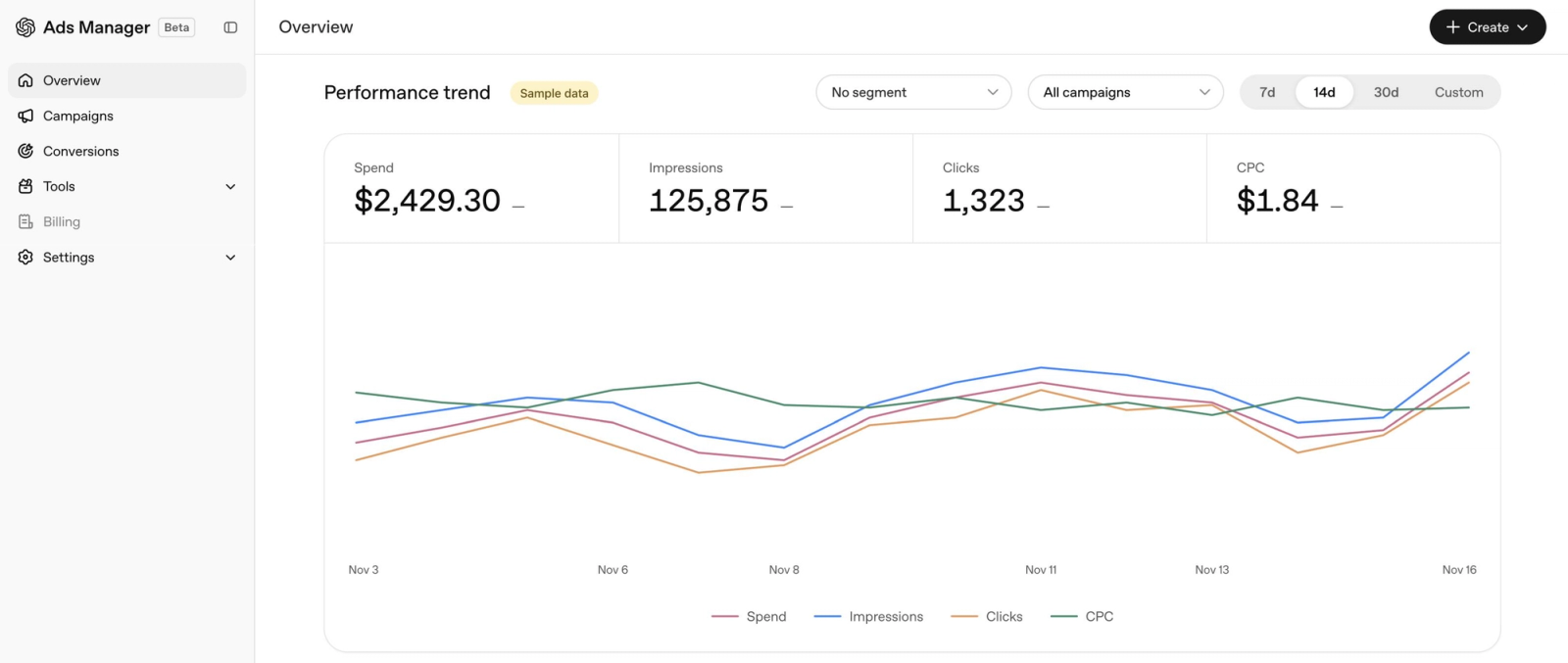
Ads Manager reports delivery, cost and conversions in aggregate. It does not show the conversations your ads appeared in.
What Ads Manager reports
OpenAI's measurement guide lists these metrics at campaign, ad group and ad level:
- Impressions, clicks and click-through rate
- Spend, average CPC and average CPM
- Conversions, if conversion measurement is set up
- Order sales and return on ad spend, from attributed order events
You can segment results by device, country and platform, chart them over time, and export CSV files. Impressions and clicks refresh about every 15 minutes. Spend can lag by 7 to 8 hours, and conversions by 24 to 48 hours.
ChatGPT ads conversion tracking
Conversion tracking uses the OpenAI Pixel, the Conversions API, or both. OpenAI appends a click reference called oppref to the landing page URL, and the Pixel stores it in a first-party cookie. The conversion guide recommends sending the same event through both methods with a shared event ID.
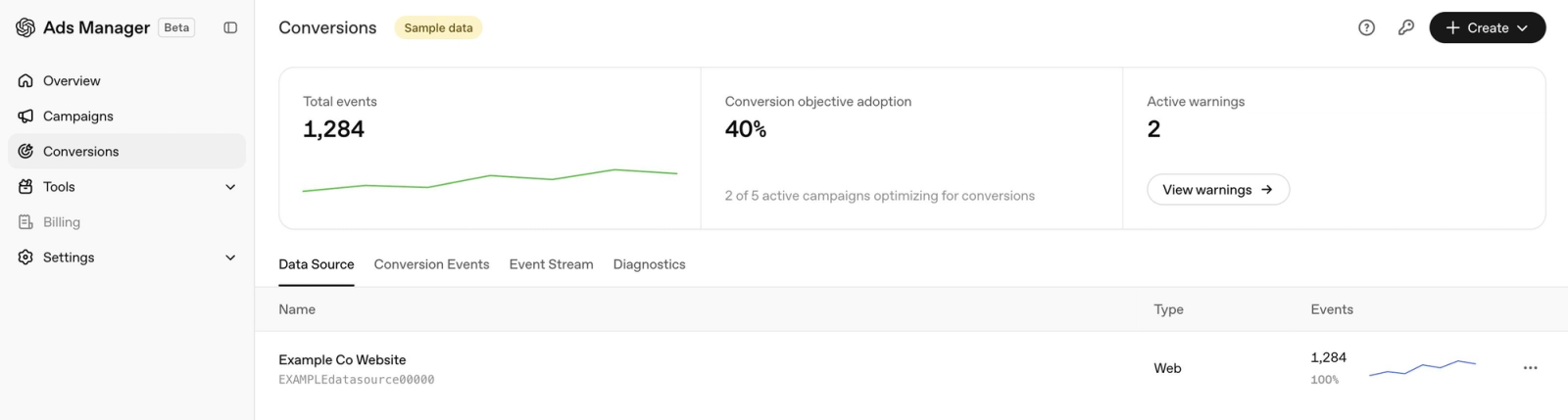
Attribution is last-touch. You choose a 7, 14 or 30-day click window and can add a 1-day view-through window. OpenAI states that this "is not multi-touch attribution". Reported totals may also include modeled conversions.
You can still use your own analytics. UTM parameters on landing page URLs persist through ad clicks. OpenAI notes that its numbers and third-party analytics may differ, and that a difference "does not necessarily indicate an error".
What Ads Manager does not show
The documentation describes no report of the prompts or conversations where an ad appeared. OpenAI tells users that advertisers receive only "aggregated, non-identifying information" about ad performance. Even for Sponsored Business Agents, advertisers see patterns across chats, not transcripts.
The documentation also describes no competitor data. You cannot see who else advertises on the same topics, or what share of relevant conversations your ads reached.
ChatGPT ads vs Google Ads
The main difference is the unit of intent. Google Search ads are matched to search terms through keywords. ChatGPT ads are matched to a conversation through context. The table compares only what each company documents.
| Question | ChatGPT Ads (OpenAI documentation) | Google Search ads (Google Ads Help) |
|---|---|---|
| What triggers an ad? | The context and intent of a conversation, plus advertiser context hints | Keywords matched to what people search for |
| How precise is the advertiser's control? | Hints inform relevance and "do not guarantee delivery" | Broad, phrase and exact match types |
| Can I exclude topics? | Negative Phrases, for qualifying advertisers only | Negative keywords exclude search terms from campaigns |
| Can I see what people typed? | No such report is documented; reporting is aggregate | The search terms report shows searches that triggered ads |
In practice, a keyword list does not transfer. Budget for a learning period, and write context hints from customer needs, not from search terms.
Paid vs organic visibility in ChatGPT
An ad buys a labeled slot under the answer. It does not change what the answer says about you. OpenAI builds the two on separate systems, so a brand can be absent from ChatGPT's recommendations while its ad runs below them.
That makes two measurement jobs. Ads Manager is first-party data on what you bought. An AI visibility platform such as Brandlight tracks the answers themselves, for the prompts you choose to monitor.
| Question | Ads Manager reporting | AI visibility platform |
|---|---|---|
| How many times was my ad shown and clicked? | Yes | No |
| What did each click or thousand impressions cost? | Yes | No |
| How many conversions followed an ad? | Yes, with the Pixel or Conversions API | No |
| Does ChatGPT name my brand in the answer itself? | No | Yes, for tracked prompts |
| Which competitors appear in the same answers? | No | Yes |
| What does the answer say about me, and is it accurate? | No | Yes |
| Which sources does the answer cite? | No | Yes |
| How do I appear in Gemini, Perplexity and Google's AI answers? | No, ChatGPT only | Yes |
Use both. Ads Manager tells you what your budget delivered. Visibility tracking tells you where you already appear without paying, and where you do not appear at all. Paid coverage is most useful where organic coverage is missing.
The unpaid side has its own playbook. Our guide to AEO vs GEO explains how brands earn mentions and citations in AI answers.
For the paid side, Brandlight's AI ads product reports which competitor ads run on answers about your brand. It also flags ad appearances that were not relevant to what you sell. It works from AI monitoring, not from an ad-platform integration, and uses no pixel.
What enterprise brands should do now
Start with a small, measured test, and measure it next to your organic presence in ChatGPT. Seven steps, in order:
- Confirm eligibility. Check your category against the ad policies and your billing entity against the country list. Regulated categories need case-by-case approval.
- Choose the buying route. Large advertisers can ask OpenAI's sales team or an agency partner. Everyone else can self-serve.
- Decide who owns the account. Country, currency and time zone are permanent. Create the account from a company-controlled login.
- Baseline your organic visibility first. Record where ChatGPT already names your brand, so you can separate paid results from unpaid ones. Our list of the best AI visibility tools compares the options.
- Install measurement before launch. Set up the Pixel and Conversions API, and add UTM parameters to every landing page.
- Start with a daily budget and several ad variations. OpenAI recommends a daily budget for new advertisers. Give the campaign time before judging it.
- Connect ads to the rest of your ChatGPT presence. Claim your profile in Business Hub, and plan for shopping agents with our guide to agentic commerce.
ChatGPT Ads is a beta, and it changes often. Recheck OpenAI's help center before each new campaign.
Subscribe to our newsletter
Get our latest posts delivered straight to your inbox.
By clicking Subscribe you're confirming that you agree with our Terms and Conditions.
Frequently asked questions
Everything you need to know about Brandlight
Does ChatGPT have ads?
Yes. ChatGPT has shown ads since February 9, 2026, when OpenAI began testing them in the United States. Ads appear below answers for adults on the Free and Go plans, with a clear label. OpenAI says Plus, Pro, Business, Enterprise and Edu accounts do not see ads.
Can you advertise on ChatGPT?
Yes. An eligible business can buy ChatGPT ads through OpenAI Ads Manager at ads.openai.com. Its legal entity must be based in one of the 89 countries on OpenAI's availability list. Larger advertisers can also buy through OpenAI's sales team, agency partners or technology partners.
How do I advertise on ChatGPT?
Sign up at ads.openai.com with an OpenAI account, create an advertiser account, and add a billing profile and card. Then build a campaign with an objective, budget and countries, add ad groups with context hints, create ads, and submit them for review. Ads serve after approval.
How much do ChatGPT ads cost?
There is no fixed price. ChatGPT ads are sold by auction, and you are billed for impressions or valid clicks, depending on your objective. The minimum daily budget for a US account is $25. OpenAI publishes no performance benchmarks, so the cost per click varies by advertiser.
What is the minimum spend for ChatGPT ads?
The minimum is a daily campaign budget that depends on your billing currency: 25 USD, 15 EUR or 15 GBP, for example. OpenAI's self-serve help pages list no contract or total spend commitment. A daily budget is an average, so spend can reach twice that amount on a single day.
Who sees ads in ChatGPT?
Adults on the Free and Go plans, in regions where ads have rolled out. OpenAI does not show ads on Plus, Pro, Business, Enterprise or Edu accounts, or to accounts identified as under 18. Ads also stay out of Temporary Chats and away from sensitive topics such as personal health, mental health and politics.
Do ads influence ChatGPT's answers?
No, according to OpenAI. It states that ads do not influence ChatGPT's answers and that ads run on separate systems from the chat model. Advertisers cannot shape, rank or alter responses. Ads are labeled and shown apart from the answer. An ad is not an endorsement.
Can I target keywords with ChatGPT ads?
No. ChatGPT Ads has no keyword bidding. Ads are matched to the context and intent of a conversation. Advertisers write context hints that describe what they offer and who it helps. OpenAI says hints are not exact-match keywords and do not guarantee delivery in specific conversations.
What is OpenAI Ads Manager?
OpenAI Ads Manager is the self-serve platform at ads.openai.com for creating, launching and measuring ChatGPT ad campaigns. It has been in beta since May 5, 2026. It covers accounts, billing, campaigns, ad groups, ads, product feeds, custom audiences, conversion tracking and reporting. Some people call it ChatGPT Ads Manager.
Which countries can advertise on ChatGPT?
OpenAI's availability page listed 89 countries and territories for self-serve access when we read it on November 16, 2026. They include the United States, United Kingdom, Canada, Australia, India, Japan, Germany, France, Brazil and Mexico. The business that advertises and is billed must be based in a listed country.
What can't you advertise on ChatGPT?
OpenAI's ad policies do not allow political content, gambling, alcohol, tobacco, adult content, dating apps, recreational drugs, counterfeit goods or unsubstantiated wellness claims. Financial, health and legal services are restricted to approved advertisers in the US, reviewed case by case. Every ad and landing page is reviewed before it runs.
How do I track conversions from ChatGPT ads?
Create a data source in Ads Manager, then send conversion events with the OpenAI Pixel, the Conversions API or both. OpenAI attributes conversions on a last-touch basis, with a 7, 14 or 30-day click window and an optional 1-day view window. UTM parameters also work with your own analytics.
Can advertisers see ChatGPT conversations?
No. OpenAI says it does not share conversations with advertisers and never sells user data. Advertisers receive aggregated, non-identifying performance information, such as total views and clicks. They do not receive chats, memories, names, email addresses or precise location. OpenAI's documentation describes no report of prompts.
What is a Sponsored Business Agent?
A Sponsored Business Agent is an ad format that lets people start a labeled chat with an AI representative of the advertiser. It is built in the Agent builder in Ads Manager and attached to a Conversions campaign. OpenAI is rolling it out to eligible advertisers and charges nothing extra for chats.
Do ChatGPT ads improve organic visibility in ChatGPT?
No. OpenAI says ads do not influence ChatGPT's answers, and products uploaded for product feed ads do not appear in organic conversations during the beta. Whether ChatGPT names your brand in an answer depends on other sources. Track paid and organic visibility separately, because separate systems produce them.